
MOON IN CAPRICORN
THE WORK
Title: Moon in Capricorn
Artist: James Havens
Year: 2026
Medium: Oil on canvas
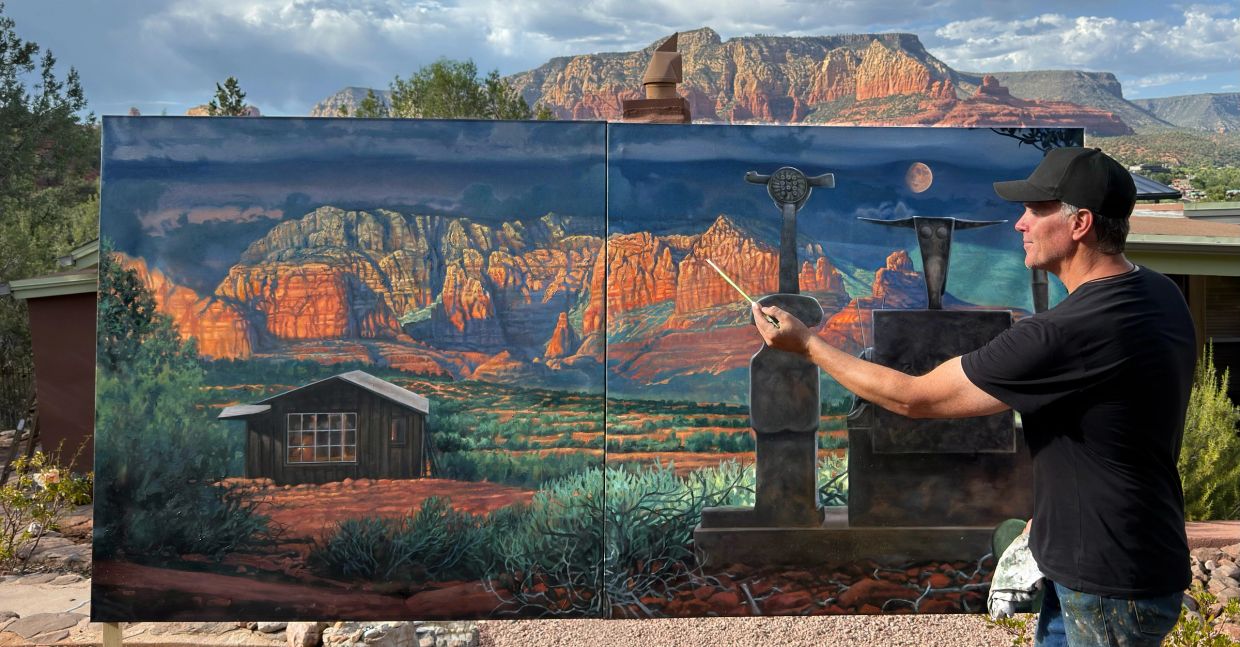
Size: Diptych, two panels 48" x 48" each — 96" x 48" overall, approx 100" x 52" installed with 1" gap and black float frames
Location depicted: Capricorn Hill, Brewer Road, Sedona, AZ with Thunder Mountain
Original: Original: Commissioned by the City of Sedona — On permanent view at Sedona City Hall, October 2026.
Inspiration: Max Ernst, Dorothea Tanning, monsoon light on the Red Rocks
Max & Dorothea in Sedona
In 1946, two titans of Surrealism — Max Ernst and Dorothea Tanning — fell in love with a patch of desert on Brewer Road in Sedona, Arizona. They built a home and studios by hand and named it Capricorn Hill. For almost ten years, this house in the red rocks was their private universe and a gathering place for the avant-garde. Here, amid Hopi katsinas and juniper trees, European Surrealism met the spirit of the American Southwest. It was here Ernst created his only monumental sculpture, _Capricorn_, and where both artists entered one of the most fertile and beloved chapters of their lives.
The Painting
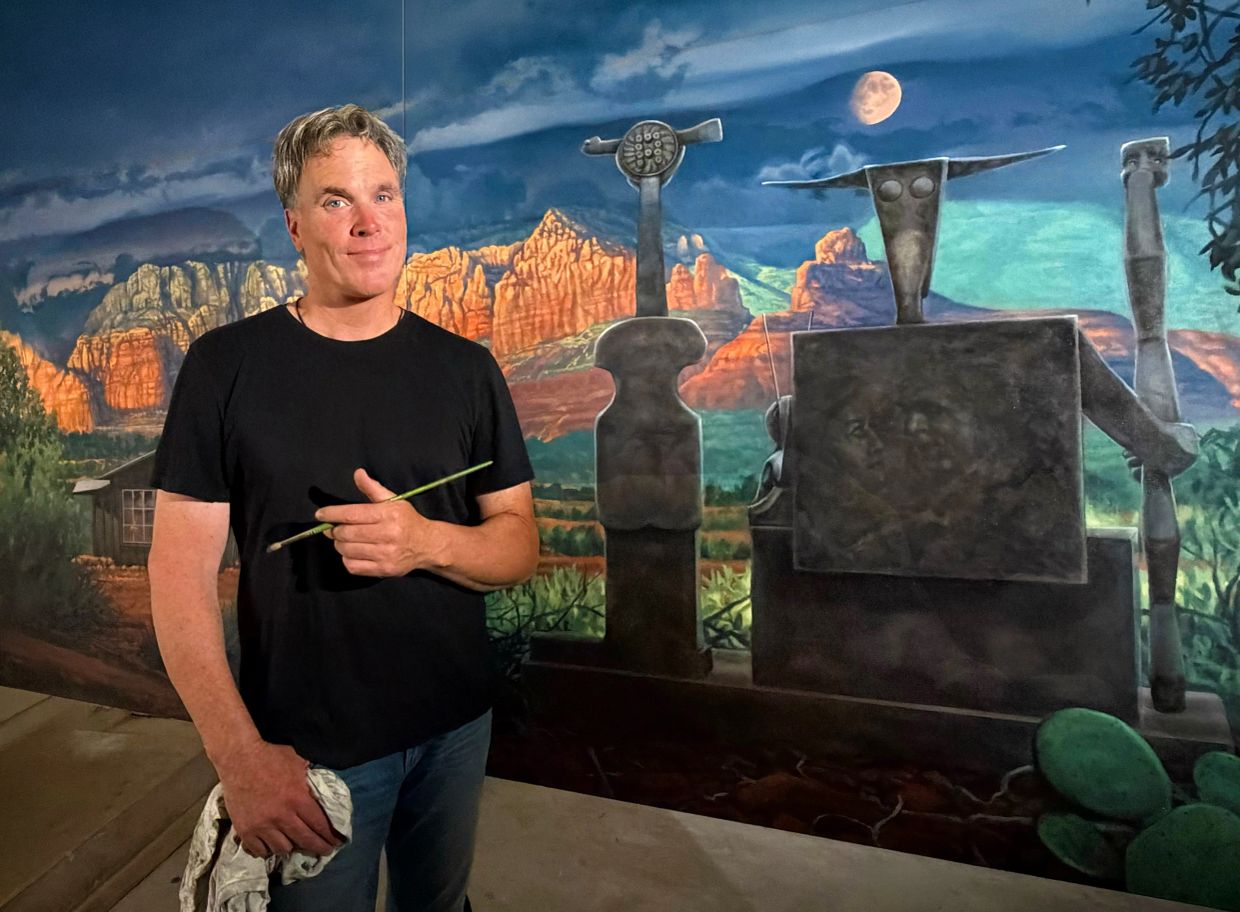
Moon in Capricorn is a surreal 8-foot wide diptych imagining Capricorn Hill at dusk — moments after a Sedona monsoon, Thunder Mountain ignited by sunset, moon rising over the desert garden. In the foreground stands Capricorn, the monumental sculpture of Max Ernst. Behind it, the small hand-built house where Ernst and Dorothea Tanning lived and worked. The light is continuous across two 4x4 ft panels, 100 inches wide with float frames.
It is both landscape and memorial — to a place where European Surrealism took root in Arizona red rock.
The History Behind the Painting
In 1946, German artist Max Ernst and American painter Dorothea Tanning left New York for the Arizona desert. Ernst said Sedona's landscape was "a parallel to the landscape of his mind."
They purchased five acres on Brewer Road and built a small house by hand. They named it Capricorn Hill.
In the summer of 1947, water was finally piped to the house after months of hauling it five miles from a well. As Dorothea Tanning wrote in her autobiography _Birthday_:
"In the summer of 1947, Max Ernst, exuberant and inspired by the arrival of water piped to our house, began playing with cement and scrap iron with assists from box tops, eggshells, car springs, milk cartons and other detritus. The result: Capricorn, a monumental sculpture of regal but benign deities that consecrated our 'garden' and watched over its inhabitants."_
Originally 95 inches tall in cement, Capricorn depicts a seated King and Queen and attendant figures — zodiacal, Hopi-inspired, and utterly Ernst. Fragile and exposed, the original was later re-worked and cast in bronze in 1964 and 1975. The major bronze now resides in the National Gallery of Art in Washington, D.C. The original site and house on Brewer Road is now preserved as the Capricorn Hill Center for Surrealism.
Moon in Capricorn is my surreal conversation with that history.
ARTIST STATEMENT
"Painting on location at Capricorn Hill, where Max Ernst and Dorothea Tanning created pivotal works, was an incredible experience. I focused on the romantic essence of their story, capturing the moment the _Capricorn_ sculpture gazes toward a moon rising in Capricorn. I wanted this piece to blend historical accuracy with a surreal, dreamlike quality — blending reality and imagination in a dramatic, sweeping composition."
Capricorn by Max Ernst
Created between 1948 and 1964, _Capricorn_ is Max Ernst's only monumental sculpture and one of the most important surrealist sculptures ever made. Originally conceived in Sedona, Arizona — where Ernst lived with Dorothea Tanning in the late 1940s — the 13-foot bronze ensemble depicts a King, Queen, and a group of fantastical attendants and animals, including a giant embracing couple and a mermaid-like figure. The work is both deeply personal and mythological, blending zodiac symbolism, tribal forms, and Ernst's signature surrealist language. First cast in concrete on their land at Brewer Road, it now stands permanently outside the Sedona Arts Center and remains a powerful monument to the creative spirit of Sedona.

The Homestead on Capricorn Hill
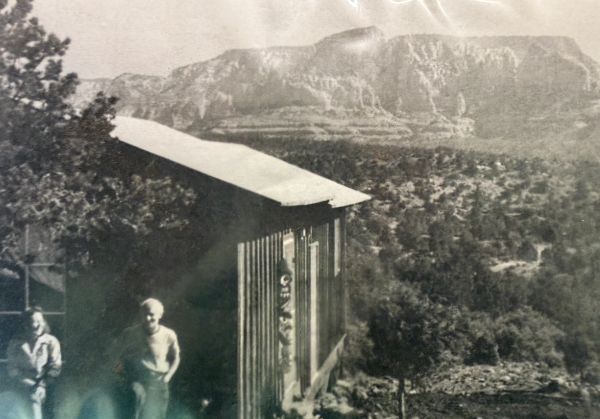
In 1946, Max Ernst and Dorothea Tanning built a home and studios by hand on Brewer Road in Sedona, which they named Capricorn Hill. For nearly a decade, this rugged sanctuary became their world — where they painted, sculpted, wrote, and lived surrounded by the red rocks. It quickly became a magnetic gathering place for the 20th century avant-garde. Their guestbook reads like a who's who of modernism: artists André Breton, Man Ray, Marcel Duchamp, Yves Tanguy, Lee Miller and Roland Penrose, Henri Cartier-Bresson, and even cultural icons like Dylan Thomas and choreographer George Balanchine came to visit.
It's that convergence — European Surrealism meeting the spirituality of the Southwest — that still makes Capricorn Hill feel so alive.
Max Ernst (1891-1976)
German-born artist Max Ernst was a pioneer of Dada and Surrealism, renowned for his invention of radical techniques like frottage and grattage that unlocked imagery from the unconscious. After fleeing war-torn Europe, he arrived in America and, in 1946, settled in Sedona, Arizona with Dorothea Tanning. In the desert landscape he found a place he had been painting his whole life without knowing it existed. In Sedona he created his only monumental sculpture, _Capricorn_, and produced some of his most important late work before returning to France in the 1950s.


Dorothea Tanning (1910-2012)
American artist Dorothea Tanning was a painter, printmaker, sculptor, and writer whose career spanned over seven decades. Emerging in New York in the 1940s as one of the key figures in Surrealism, she became known for her hauntingly beautiful dreamscapes, prismatic abstractions, and soft textile sculptures. In 1946 she moved to Sedona's Capricorn Hill with Max Ernst, where the vast desert and light profoundly shaped her work. Fiercely independent and endlessly inventive, Tanning continued to evolve until her death at 101, leaving a legacy as one of the most visionary artists of the 20th century.
MARK ROWNED | Capricorn Hill Center For Surrealism
Keeping the Story Alive
Capricorn Hill, the property Max Ernst and Dorothea Tanning built with their own hands, is now in the care of Mark Rowned — an extraordinary musician, art lover, and steward of this creative legacy. Mark offers intimate tours of the property, sharing stories of the artists who walked those trails and the magic that still lives there. His passion for preserving this sacred place ensures the spirit of Ernst and Tanning's Sedona years continues to inspire. [Learn more and book a tour with Mark Rowned] (https://capricornhill.org/ )
CONTACT: USA 714.464.8500 E-MAIL: surrealsedona@gmail.com
THE CITY OF SEDONA | Nancy Lattanzi
SPECIAL THANKS TO "THE CITY OF SEDONA"
A very special thank-you to Nancy Lattanzi at the Arts & Culture department for the City of Sedona! Thank you hosting this important event!
Learn more about the arts in Sedona by visiting the City of Sedona website: